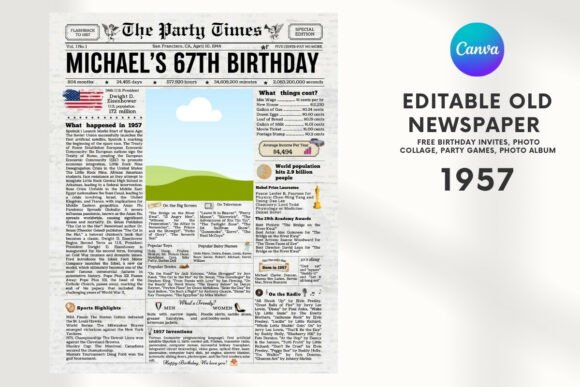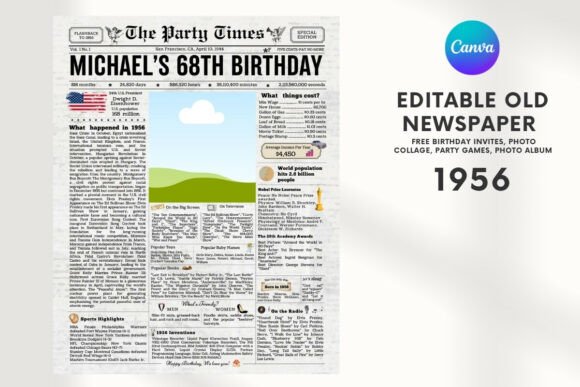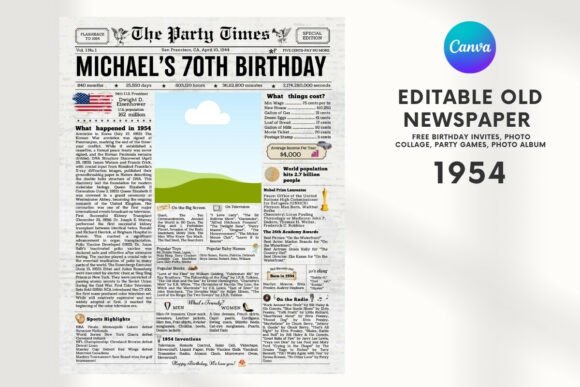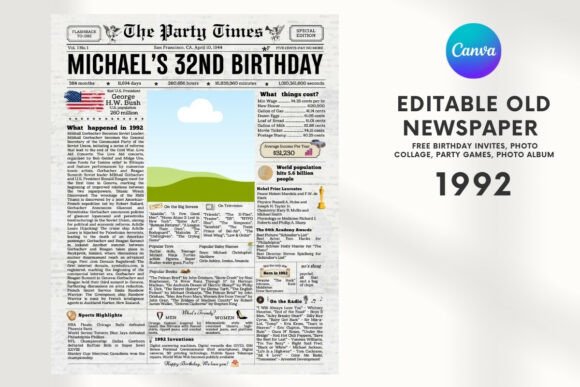
Why the EDITABLE 1958 Birthday Vintage Newspaper Is Reshaping How We Celebrate Milestones
In an era defined by digital saturation and fleeting attention spans, meaningful celebration has become both a challenge and a priority. Professionals, creators, entrepreneurs, marketers, and lifestyle enthusiasts are increasingly seeking tools that bridge authenticity with intentionality—ones that honor personal history while fitting seamlessly into modern workflows. Enter the EDITABLE 1958 Birthday Vintage Newspaper: not just a design template, but a culturally resonant storytelling instrument engineered for today’s discerning celebrants and planners.
A Nostalgic Format, Reimagined for Contemporary Creativity
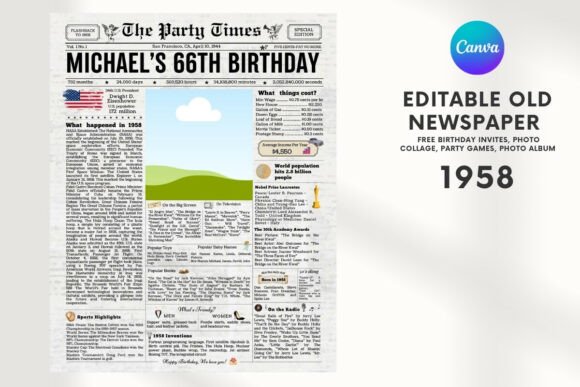
The EDITABLE 1958 Birthday Vintage Newspaper is a meticulously crafted Canva-based digital template that evokes the typographic warmth, layout rhythm, and editorial charm of mid-century print journalism—specifically echoing the visual language of newspapers from 1958. Yet it’s far from a static retro prop. Its true innovation lies in its editability: every headline, byline, photo caption, weather report, and “classified ad” section is fully customizable. Users can insert real-life milestones (“Graduated Magna Cum Laude, 2012”), playful trivia (“Can identify 17 bird calls by ear”), or heartfelt tributes (“The person who taught us patience—and how to fix a leaky faucet”).
This isn’t nostalgia as decoration. It’s nostalgia as scaffolding—a familiar, trusted format repurposed to organize and elevate personal narrative. In doing so, the template responds directly to a growing cultural shift: the move from transactional event planning to meaning-driven experience design. Whether you're a freelance designer crafting a client’s 60th birthday surprise, a marketing manager launching an internal recognition campaign, or an entrepreneur hosting a milestone launch party, this tool enables storytelling with gravitas and grace.
Fitting Into Broader Creative and Consumer Trends
The rise of the EDITABLE 1958 Birthday Vintage Newspaper aligns with several converging trends across creative, technological, and behavioral domains:
- The Analog Revival in Digital Workflows: From film photography filters to typewriter-style fonts in pitch decks, professionals are integrating tactile, human-scaled aesthetics into digital-first processes. This template doesn’t ask users to abandon their laptops—it invites them to reinterpret digital efficiency through analog-inspired structure.
- Personalization at Scale: Consumers no longer settle for generic greetings. Platforms like Canva have democratized high-fidelity customization, and users now expect templates that offer both polish and flexibility. The 1958 newspaper delivers precisely that: professional-grade typography and grid systems, paired with intuitive drag-and-drop editing—no design degree required.
- Memory as Medium: Neuroscience and behavioral research confirm that multi-sensory, context-rich experiences deepen memory encoding. A printed newspaper—tactile, visually layered, physically browsable—creates a stronger emotional anchor than a slideshow or social media post. It transforms celebration from passive viewing into active engagement.
- Sustainability-Conscious Curation: As eco-awareness grows among creatives and brands, there's rising demand for reusable, low-waste celebration assets. Unlike single-use decor or disposable invites, this template supports iterative use—adapted for different ages, themes, or even corporate anniversaries—making it a responsible choice for mindful planners.
Why Professionals Are Choosing This Template—Beyond Aesthetics
It’s not just about looking good. It’s about working smarter—and connecting more deeply.
Consider a marketing director organizing a 25th-anniversary gala for her agency. Instead of relying solely on PowerPoint retrospectives, she uses the EDITABLE 1958 Birthday Vintage Newspaper to publish a “special edition” commemorating key campaigns, team milestones, and client testimonials—all framed as front-page news. Colleagues receive printed copies upon arrival; digital versions are embedded in the event microsite. The result? A cohesive, immersive narrative that reinforces brand legacy without sounding self-congratulatory.
Or take a freelance illustrator preparing a surprise for her mentor’s 70th birthday. She populates the template with hand-drawn illustrations scanned and placed as “spot illustrations,” writes imagined “interviews” with former students, and includes a vintage-style “weather forecast” reading: “Sunny skies, light laughter, occasional tears of joy.” She exports the file, prints on cream linen paper, and binds it as a keepsake. Here, the template functions as a collaborative canvas—not replacing creativity, but focusing and elevating it.
For entrepreneurs launching a product tied to heritage or craftsmanship (e.g., small-batch whiskey, heirloom textiles), the same template becomes a launch asset: rebranded as a “Founders’ Chronicle,” it tells origin stories with journalistic weight—lending credibility and emotional resonance to market entry.
Meeting Evolving Expectations in Real Time
User expectations have shifted dramatically in just five years. Today’s planners don’t want “templates”—they want frameworks. Frameworks that respect their time, amplify their voice, and adapt to shifting needs. The EDITABLE 1958 Birthday Vintage Newspaper meets those expectations by:
- Reducing cognitive load: Its structured sections (Obituaries—reimagined as “Life Highlights”; Stock Market—reframed as “Mood Index”; Sports Section—transformed into “Hobbies & Achievements”) provide intuitive storytelling guardrails—no blank-canvas anxiety.
- Supporting hybrid execution: Designed for seamless export to PDF, PNG, or print-ready CMYK, it works equally well for physical invitations, digital e-newsletters, or interactive kiosks at events.
- Enabling inclusive participation: Teams or families can co-edit via Canva’s real-time collaboration, turning preparation into shared ritual—not solo labor.
- Scaling with purpose: One file serves multiple roles—birthday invite, ceremony program, guestbook alternative, or archival artifact—eliminating redundant design tasks.
More Than a Template—A Cultural Touchstone in the Making
What makes the EDITABLE 1958 Birthday Vintage Newspaper distinctive isn’t its year-specific styling alone—it’s how that styling functions as a deliberate counterpoint to our present moment. In 1958, newspapers were trusted authorities, community touchstones, and daily rituals. Today, we’re rebuilding trust—not in institutions, but in intention. Every headline written, every photo selected, every “ad” placed for a favorite book or song is an act of curation rooted in care.
This resonates powerfully with professionals who understand that influence isn’t built through volume—but through resonance. A beautifully rendered birthday newspaper doesn’t shout. It invites. It lingers. It gets folded into a drawer—and pulled out again on future birthdays, anniversaries, or quiet evenings when someone wants to remember what mattered.
That durability—emotional and functional—is why designers are embedding these newspapers into client onboarding kits, why HR teams are using them for retirement send-offs, and why educators are adapting them for student portfolio presentations. It’s a format that refuses obsolescence because it centers humanity over trend.
Your Next Milestone, Thoughtfully Framed
The EDITABLE 1958 Birthday Vintage Newspaper doesn’t ask you to slow down—it asks you to show up. To pause long enough to select the right photo, write the right anecdote, choose the right font size for a beloved quote. In doing so, it transforms celebration from performance into presence.
Whether you’re a solopreneur designing your first signature offering, a global brand rethinking internal culture, or a parent planning a child’s first “big kid” birthday, this template offers something rare in today’s creative toolkit: structure that inspires, not constrains. It’s ready when you are—download, personalize, print, and let the story unfold.
Because some moments deserve more than a post. They deserve a front page.