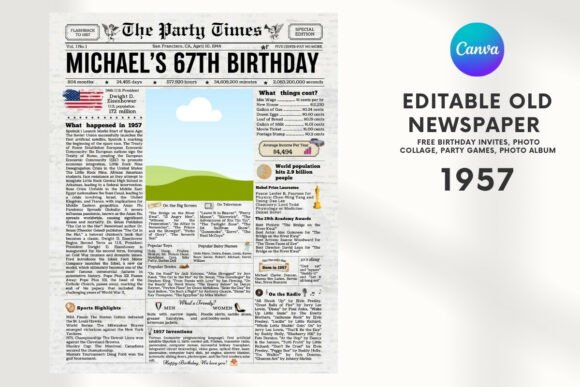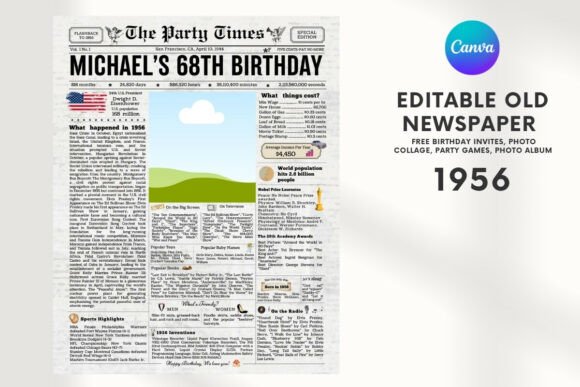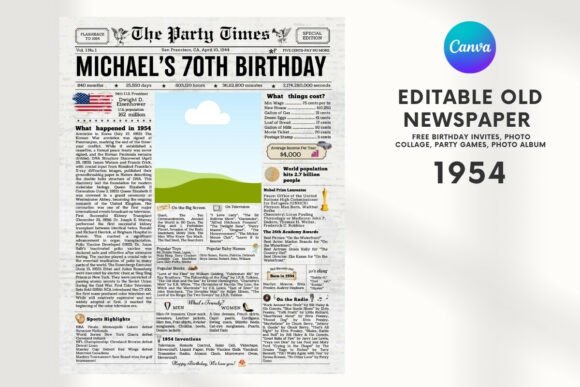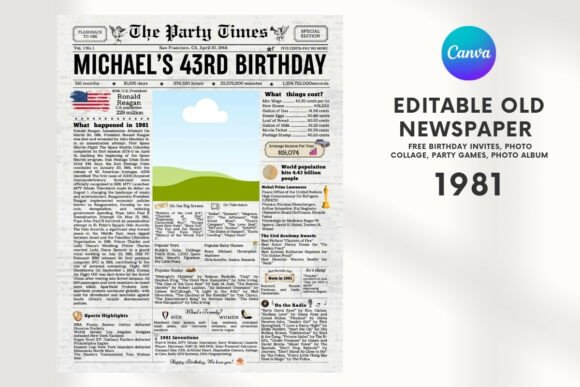
EDITABLE 1992 Birthday Vintage Newspaper
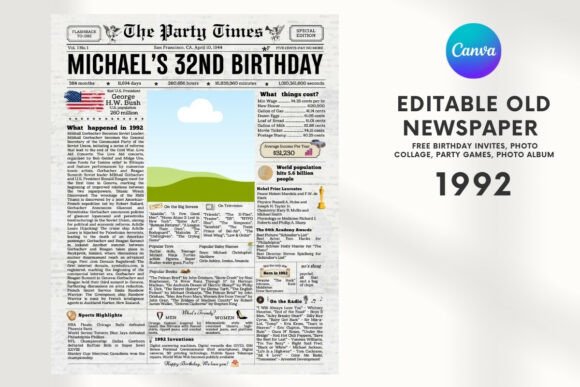
The EDITABLE 1992 Birthday Vintage Newspaper is a digital Canva template designed to help users create a custom, retro-styled newspaper centered around a person’s birthday. It is not a physical reproduction of a 1992 newspaper, nor does it contain real historical content from that year. Instead, it uses vintage typography, layout conventions (e.g., masthead, columned text, serif fonts), and design motifs reminiscent of early-1990s print media to evoke nostalgia. All text, images, dates, headlines, and sections—including “Life in Review,” “Top Moments,” “Fun Facts,” and “Celebrity Lookalikes”—are fully editable within Canva.
People often seek this template when planning milestone birthdays—such as 30th, 40th, 50th, or 60th celebrations—where personal storytelling and thematic cohesion matter. Its appeal lies in offering a structured yet flexible format for compiling biographical highlights, humor, photos, and meaningful anecdotes in a visually distinctive way. Unlike generic invitation or photo collage tools, the newspaper format encourages narrative framing: turning life events into “front-page news,” achievements into “feature stories,” and inside jokes into “opinion columns.” This makes it especially relevant for those who value creativity, personalization, and tactile keepsakes.
One key benefit is accessibility. Since it operates within Canva—a free, browser-based platform—no specialized design software or technical skills are required. Users can replace placeholder text, upload personal photos, adjust colors to match party themes, and export high-resolution PDFs for home or professional printing. The template also supports multilingual editing, making it adaptable across diverse cultural contexts. Another advantage is reusability: the same file can be duplicated and modified for future birthdays or adapted for anniversaries, retirements, or graduation celebrations with minimal effort.
However, there are tradeoffs to consider. Because it is a template—not a guided service—users must supply all content and make editorial decisions independently. That includes writing compelling headlines, selecting representative photos, verifying factual accuracy (e.g., birthdate, school names, job titles), and ensuring tone consistency across sections. For some, this level of creative responsibility may feel time-consuming or daunting, particularly if they lack confidence in writing or visual composition. Additionally, while Canva offers intuitive drag-and-drop tools, fine-tuning complex layouts—such as aligning multi-column text with image cutouts—may require familiarity with Canva’s layering and spacing controls.
Printing quality depends on user choices. The template exports at 300 DPI, suitable for standard commercial printing, but results vary based on paper stock, printer calibration, and color profiles. Glossy or matte photo paper enhances the vintage effect; plain copy paper may dull contrast and reduce perceived authenticity. Also, because the design emulates 1992 aesthetics—not current design trends—it may feel stylistically mismatched for modern, minimalist, or ultra-contemporary events. Those prioritizing sleek, monochrome, or digital-first experiences (e.g., QR-code-driven invites or interactive web pages) may find the newspaper format less aligned with their goals.
The EDITABLE 1992 Birthday Vintage Newspaper is a strong fit when:
- You’re organizing an in-person or hybrid celebration where physical mementos hold meaning;
- The celebrant has a fondness for analog media, history, or mid-’90s pop culture;
- You have access to photos, anecdotes, and milestones you’d like to curate into a cohesive story;
- You prefer a consistent visual language across invitations, signage, and guest takeaways;
- You want a reusable framework that supports iterative updates—say, adding new “annual editions” each year.
Conversely, alternatives may be more appropriate in several cases. If your priority is speed over customization, pre-written, fill-in-the-blank invitation services (e.g., Paperless Post or Greenvelope) offer faster turnaround with built-in RSVP tracking. For highly visual or data-rich storytelling—such as illustrating career progression, travel history, or family trees—a custom infographic or timeline tool (like Venngage or Flourish) may provide greater flexibility in chart types, interactivity, and responsive scaling. If accessibility is essential—for example, for guests with low vision or screen reader dependence—static PDF newspapers lack semantic structure and alt-text support unless manually enhanced, whereas HTML-based invites allow proper ARIA labeling and font resizing.
Practical decision-making starts with clarifying intent. Ask yourself: Is the goal to inform, entertain, commemorate, or all three? If commemoration is primary, the newspaper’s narrative scaffolding supports reflection and legacy-building. If entertainment drives the event, consider whether guests will engage with long-form text—or if shorter, scannable formats (e.g., illustrated quote cards or trivia games) better suit attention spans. Also assess available time: creating a polished newspaper typically requires 2–6 hours, depending on content depth and design iteration. Setting aside dedicated blocks for writing, photo selection, and proofreading helps avoid last-minute compromises.
Another consideration is audience alignment. Older adults or lifelong readers may respond warmly to the tactile, nostalgic cues—the slightly off-kilter kerning, faux-newsprint texture, and typewriter-style headlines. Younger guests might appreciate the novelty but engage more with shareable digital versions (e.g., a Canva link embedded in an email or printed as a QR code). Testing a draft with one or two representative guests can reveal whether tone, humor, or references land as intended.
Finally, think beyond the single use. While marketed for birthdays, the template’s structure adapts well to other life chapters: retirement retrospectives, wedding “day-in-review” summaries, or even classroom projects about personal history. Its value increases if you anticipate repurposing—not just as decoration, but as a lightweight archival tool. That said, it does not replace formal documentation (e.g., scanned certificates or oral histories), nor does it include prompts for deeper reflection (e.g., “What advice would your 10-year-old self give you today?”). Supplementing it with guided journaling or interviews can deepen authenticity without overcomplicating the design process.
In summary, the EDITABLE 1992 Birthday Vintage Newspaper serves a specific niche: those seeking a hands-on, design-led method to translate personal history into a shareable, collectible artifact. It balances structure with openness, nostalgia with relevance, and simplicity with expressive potential. Whether it fits your needs depends less on trendiness and more on how thoughtfully you align its capabilities with your purpose, audience, and available resources.