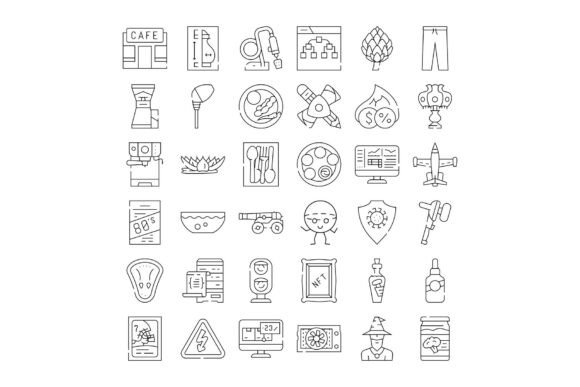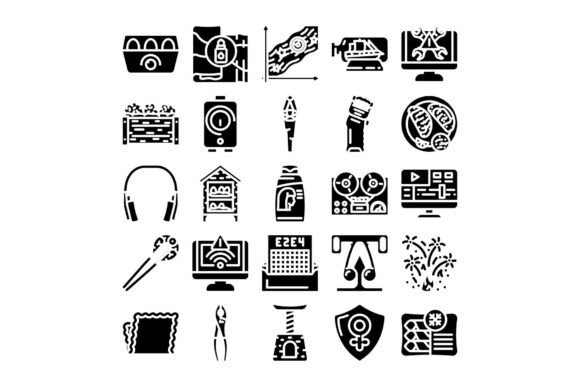
Universal Glyph Collection Illustrating
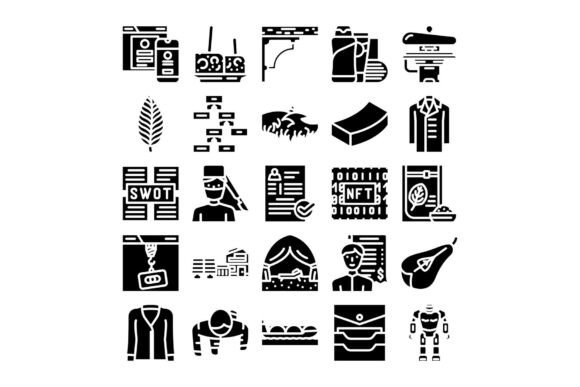
The Universal Glyph Collection Illustrating is a curated, standardized set of minimalist, scalable vector symbols designed to represent a broad spectrum of objects, tools, technologies, and abstract concepts. Unlike icon libraries tied to specific design systems or stylistic trends, this collection prioritizes semantic clarity, cross-cultural recognizability, and functional versatility. Each glyph adheres to consistent stroke weight, proportion, and visual grammar—enabling seamless integration across interfaces, infographics, educational materials, and creative projects.
Why Evaluate the Universal Glyph Collection Illustrating?
Designers, educators, product teams, and content strategists often face recurring challenges: conveying complex ideas quickly; maintaining visual consistency across multilingual or multimodal outputs; and reducing cognitive load in data-dense environments. The Universal Glyph Collection Illustrating responds to these needs—not as a one-size-fits-all solution, but as a rigorously structured resource for intentional symbol use. Its value emerges most clearly when users prioritize interoperability, scalability, and conceptual precision over stylistic novelty or brand-specific ornamentation.
Key Benefits for Practical Use
- Consistency across contexts: Uniform construction rules ensure glyphs retain legibility whether scaled from 16px UI elements to 300dpi print infographics.
- Conceptual breadth: Covers tangible items (e.g., wrench, microscope, server rack) alongside abstractions (e.g., recursion, equity, latency), supporting both technical documentation and inclusive communication.
- Language-agnostic utility: Designed with minimal reliance on culturally specific metaphors—making it especially useful for global applications where text labels may vary or be omitted entirely.
- Technical flexibility: Delivered in SVG format with clean paths and semantic naming, easing integration into design systems, code-based UI frameworks, and automated documentation pipelines.
Tradeoffs and Realistic Expectations
No glyph system eliminates all interpretation ambiguity—and the Universal Glyph Collection Illustrating is no exception. Because it emphasizes universality over expressiveness, some glyphs may feel less distinctive or emotionally resonant than hand-crafted alternatives. Users should expect to invest time in reviewing the included usage guidelines: certain symbols assume baseline domain knowledge (e.g., a glyph representing “quantum superposition” presumes audience familiarity with core physics concepts). Additionally, while the collection supports rapid prototyping, fine-tuning for accessibility—such as verifying color contrast ratios or adding ARIA labels in interactive contexts—remains the implementer’s responsibility.
It does not include animated variants, multi-state icons (e.g., toggled on/off), or contextual illustrations (e.g., a person using a tool). Those needs typically require supplemental assets or custom extension—not substitution.
Situations Where It Fits Strongly
The Universal Glyph Collection Illustrating aligns well with projects where clarity, reuse, and long-term maintainability outweigh decorative or marketing-driven goals. For example:
- Technical documentation systems that serve diverse engineering teams across regions—where consistent symbol meaning reduces translation overhead and misinterpretation risk.
- Educational platforms building modular learning modules on topics like digital literacy, sustainability, or computational thinking—where glyphs act as visual anchors for recurring concepts.
- Government or NGO dashboards communicating public health, infrastructure, or climate metrics to mixed-audience stakeholders—where neutrality and immediate recognition support equitable information access.
- Design system foundations seeking vendor-neutral, license-permissive base assets before layering on brand-specific styling or interaction states.
When Alternatives May Be More Appropriate
Consider other resources if your work centers on:
- Brand differentiation: If visual uniqueness or emotional tone is critical—such as consumer-facing apps where icon personality reinforces identity—the Universal Glyph Collection Illustrating’s neutral aesthetic may require significant customization to meet strategic goals.
- Highly specialized domains: Fields like medical imaging or aerospace engineering often rely on tightly regulated, industry-standard symbols (e.g., ISO/IEC 80000). In those cases, domain-specific glyph sets—not universal ones—ensure regulatory compliance and professional trust.
- Rapid iteration with heavy visual feedback: Teams relying on real-time user testing of icon comprehension may find the collection’s emphasis on conceptual fidelity less adaptable than more illustrative or pictorial icon families during early-stage validation.
- Low-bandwidth or legacy environments: While SVG files are lightweight, some embedded systems or older assistive technologies perform better with raster-based icon sprites or icon fonts—formats the collection does not natively provide.
Making an Informed Decision
To determine whether the Universal Glyph Collection Illustrating suits your needs, start by auditing your current symbol usage. Ask: Are inconsistencies in icon style or meaning causing confusion in user testing or localization? Do you repeatedly redraw or re-specify similar symbols across documents or products? If yes, standardization offers measurable efficiency gains.
Next, assess your audience’s likely familiarity with symbolic conventions. Run a small internal check: present 5–10 glyphs from the collection alongside their intended meanings to representative users. Note where interpretations diverge—not as failure, but as insight into necessary contextual support (e.g., pairing glyphs with brief labels in first-use scenarios).
Finally, examine licensing and maintenance requirements. The collection is typically offered under permissive open licenses (e.g., CC BY-SA or MIT), but verify attribution expectations and version update policies. If your team lacks capacity to manage updates or adapt glyphs for evolving standards (e.g., WCAG 2.2 contrast requirements), factor in the cost of ongoing curation.
Conclusion
The Universal Glyph Collection Illustrating is a tool for intentionality—not convenience alone. It supports teams aiming to reduce ambiguity, scale visual language responsibly, and build shared understanding across disciplines and geographies. Its strength lies not in replacing thoughtful design decisions, but in providing a reliable, extensible foundation for them. Whether used wholesale, selectively, or as inspiration for custom development, its value is clearest when aligned with goals centered on clarity, consistency, and long-term usability—rather than speed of implementation or stylistic impact alone.