Outline Icons Collection Forming a Diver: A Versatile Toolkit for Visual Clarity and Design Efficiency
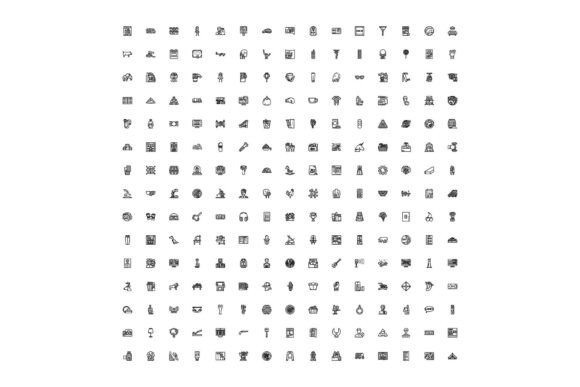
At first glance, the phrase Outline Icons Collection Forming a Diver may evoke curiosity—how can a set of minimal line art icons coalesce into a recognizable figure like a diver? The answer lies not in literal illustration, but in intentional design logic: this curated collection is structured so that its individual icons—when arranged thoughtfully—can collectively outline or suggest the silhouette of a diver. More importantly, it represents a broader principle in modern visual communication: the power of modular, scalable, and semantically coherent iconography. Unlike monolithic illustrations or raster-based graphics, these icons are built on clean vector paths, consistent stroke weights, and harmonized proportions—making them ideal for responsive interfaces, data visualization, educational materials, and cross-platform branding.
What Defines This Collection’s Architectural Integrity?
The strength of the Outline Icons Collection Forming a Diver isn’t rooted solely in aesthetics—it emerges from deliberate structural discipline. Each icon adheres to a unified visual grammar: 1.5px stroke weight at standard scale, 4px corner radius on rounded elements, consistent negative space ratios, and strict alignment to a 24×24 pixel grid. This consistency enables seamless mixing—whether pairing a scuba tank icon with a water droplet, a compass, or a depth gauge to build underwater-themed infographics. Crucially, the “diver” formation isn’t a single composite image; it’s an emergent property. When designers place icons such as swim goggles, flippers, oxygen regulator, buoyancy vest, and diving flag in sequence along a curved path, they trace the posture and motion of a diver descending. This modularity supports both literal interpretation and metaphorical use—e.g., representing exploration, depth of analysis, or immersion in learning.
Real-World Applications Across Diverse Fields
Because the collection spans over 320 subjects—including science, education, environment, health, technology, transportation, and daily life—it serves practitioners far beyond marine-themed projects. Educators use the microscope, brain, and book stack icons alongside diver-associated symbols to visualize cognitive “descent” into complex topics—such as scaffolding lessons on ocean ecosystems or neural pathways. In healthcare, clinicians integrate heart rate, lung, and stethoscope icons with pressure gauge and water wave to explain decompression sickness or respiratory physiology—making abstract medical concepts tangible through layered iconography.
Business analysts leverage the collection’s coherence when building dashboards. A financial services firm might combine graph up, shield, lock, and diving bell to signal “secure, deep-dive data analysis.” Similarly, sustainability reports benefit from pairings like coral reef, recycle arrow, thermometer, and diver silhouette—reinforcing themes of environmental stewardship and measured intervention. Even software developers embed these icons in documentation: using code bracket, server rack, and submerged cable to depict backend architecture “beneath the surface” of user interfaces.
Why Minimal Line Art Delivers Maximum Functional Value
Minimal line art isn’t merely a stylistic preference—it’s a functional necessity in today’s multi-device, high-accessibility landscape. These icons render crisply at 12px (for tooltips) and scale cleanly to 96px (for presentation slides), without anti-aliasing artifacts or file bloat. SVG format ensures tiny payloads—most icons average under 0.8 KB—and full accessibility support via aria-label attributes and semantic grouping. Unlike filled-color icons, outline variants adapt effortlessly to dark mode, inverted color schemes, and branded palettes: a single icon set can be recolored via CSS variables to match any UI theme without exporting new assets.
This flexibility proves especially valuable for creators managing version-controlled design systems. Because every icon shares identical anchor points and bounding boxes, swapping one symbol for another—say, replacing boat with submersible in a maritime workflow diagram—requires no layout recalibration. That predictability reduces handoff friction between designers, developers, and content strategists, accelerating iteration cycles while preserving visual integrity.
Designers, Educators, and Researchers: Who Benefits Most?
Graphic designers appreciate the collection’s interoperability with Figma, Adobe Illustrator, and Sketch—each icon imports as editable vector paths, supporting custom stroke adjustments, Boolean operations, or kinetic animation. There’s no vendor lock-in; no proprietary formats. For educators building open educational resources (OER), the royalty-free license allows unrestricted use in textbooks, LMS modules, and printed handouts—even for commercial training programs—as long as attribution is provided.
Researchers compiling literature reviews or meta-analyses find value in the iconography’s semantic precision. Rather than defaulting to generic clipart, they select icons with clear conceptual anchors: peer review (two overlapping circles with checkmarks), data lake (a stylized basin with flowing lines), or hypothesis loop (a circular arrow enclosing a question mark). When combined with diver-associated motifs—like deep focus lens or sonar pulse—they reinforce methodological rigor and investigative depth.
Hobbyists and small business owners benefit from immediacy. A local dive shop can assemble social media posts using calendar, location pin, certification badge, and diver formation icons—all in under five minutes—without hiring a designer. A podcast host exploring themes of curiosity and discovery might animate the diver outline across episode thumbnails, subtly evolving its components each week: adding magnifying glass in one episode, lightbulb in another, world map in a third—creating visual continuity without repetition.
Implementation Considerations: Beyond Aesthetics
Adopting the Outline Icons Collection Forming a Diver requires attention to context—not just compatibility. First, assess contrast ratios: while thin strokes enhance minimalism, they may fail WCAG 2.1 AA standards below 16px on light backgrounds. Solution? Use CSS stroke-width overrides or provide fallback solid variants for critical UI elements. Second, consider cultural resonance: the diver motif carries positive connotations in Western contexts (exploration, courage), but may evoke occupational hazard or colonial extraction in certain coastal communities. Thoughtful pairing—e.g., combining indigenous canoe, seaweed harvest, and tide chart—ensures respectful representation.
Third, avoid overloading. A common misstep is clustering too many icons into a single visual hierarchy, diluting meaning. Instead, apply the “three-icon rule”: limit primary groupings to three related symbols to maintain scannability. For example, a climate education slide might show iceberg, temperature rise arrow, and diver with measuring tape—signaling measurement beneath visible surfaces—rather than adding six supporting icons.
How This Collection Fits Within Broader Design Trends
The Outline Icons Collection Forming a Diver reflects two converging macro-trends: the resurgence of semantic iconography and the demand for design sovereignty. Semantic iconography moves beyond decoration toward functional literacy—icons that communicate precise ideas, not vague associations. A diver with clipboard signals field data collection more effectively than a generic document icon. Meanwhile, design sovereignty responds to growing skepticism of SaaS-dependent tools: creators increasingly seek self-hosted, customizable, license-transparent assets. This collection meets both needs—it’s downloadable as a ZIP, documented in plain English, and designed for modification, not just consumption.
It also anticipates AI-augmented workflows. As generative tools improve at icon synthesis, human curation becomes more valuable—not less. An AI might produce dozens of “diver” icons, but only a carefully assembled collection offers guaranteed consistency, intentional metaphors, and contextual versatility. The Outline Icons Collection Forming a Diver doesn’t compete with AI; it empowers users to guide it, feeding precise prompts like “generate a flowchart using only icons from the diver-aligned subset: pressure, visibility, buoyancy, time” — ensuring outputs remain grounded in shared visual language.
Practical Integration Pathways
Getting started requires no specialized software. For static websites, link the SVG sprite directly and reference icons by ID: . In React applications, import individual icons as components—enabling dynamic coloring and responsive sizing. For print projects, export PDFs at 300 DPI with embedded fonts disabled (since these are pure vectors, no text dependencies exist). And for collaborative environments, store the collection in a shared cloud folder with a simple README listing categories (e.g., “Marine Equipment,” “Cognitive Tools,” “Environmental Metrics”) and usage notes.
Most importantly, treat the collection as a living vocabulary—not a fixed library. Add your own variations: extend the diver formation with locally relevant symbols (e.g., coral polyp, salinity meter, marine archaeology brush) and contribute back to community repositories. That ethos—of clarity, collaboration, and contextual intelligence—is what transforms a set of line drawings into a foundational resource for meaningful communication.