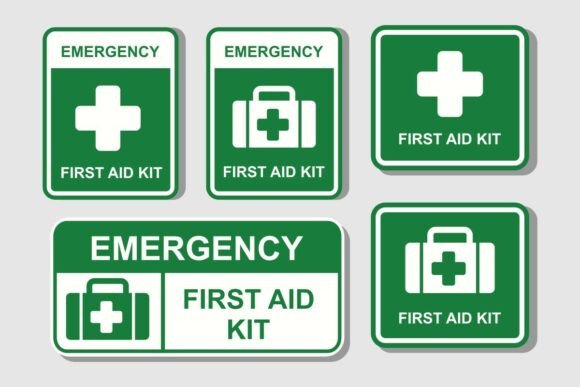
First Aid Kit Emergency Signs and Symbol
When seconds count, clarity saves lives. First Aid Kit Emergency Signs and Symbol isn’t just another design asset—it’s a precision-crafted visual language built for urgency, comprehension, and universal recognition. This collection delivers a complete set of vector-based signage elements: from the classic white cross on a green background to directional arrows pointing to treatment areas, from “Emergency Assistance” call-out icons to standardized safety information labels—all designed with clean lines, bold solid colors, and intentional negative space.
Why visual consistency matters in high-stakes environments
In hospitals, schools, or manufacturing facilities, inconsistent or ambiguous signage can delay response time—not by minutes, but by critical seconds. A poorly rendered medical cross might be mistaken for a generic logo; a cluttered directional sign could confuse someone under stress. The First Aid Kit Emergency Signs and Symbol collection eliminates that risk. Each symbol adheres to ISO 7010 and ANSI Z535 standards where applicable, ensuring alignment with internationally recognized safety communication principles. That means your clinic’s hallway signage, your school’s emergency drill posters, or your workplace’s OSHA-mandated labeling all communicate the same message—without translation, without hesitation.
Scalability that works—from door decals to digital interfaces
SVG and EPS formats aren’t just technical details—they’re functional advantages. Whether you’re printing a 2-inch sticker for a portable first aid kit or scaling a directional sign to fit a 10-foot corridor wall, these vectors retain crisp edges and color fidelity. Designers integrating them into mobile apps or web-based safety training modules benefit equally: no pixelation, no reworking, no version control headaches. One file adapts cleanly across print, screen, and physical installations—cutting production time and reducing revision cycles.
Real-world applications across diverse settings
A small business owner installing new signage in a shared office space can use the “First Aid Station” marker and “Emergency Exit Route” arrow to meet local fire code requirements—without hiring a designer. An educator developing a classroom safety curriculum pulls the “Treatment Area” icon and “Poison Control Hotline” label directly into editable slides, reinforcing key concepts visually. A freelance UX designer building an emergency preparedness app selects only the symbols needed—like “AED Location” or “Burn Treatment Zone”—then recolors them to match the app’s palette using built-in vector editing tools.
Even non-design professionals gain leverage. Facility managers updating aging signage can replace outdated PDFs or raster images with these vectors, then adjust text labels or add facility-specific numbering—all within common software like Adobe Illustrator or Affinity Designer. No need to outsource minor edits.
Clarity through intentional minimalism
The flat vector style isn’t just trendy—it serves function. By stripping away gradients, shadows, and decorative flourishes, each symbol prioritizes immediate legibility. A red “Emergency Assistance” hand icon uses contrast and proportion to signal urgency; a blue “Decontamination Area” marker relies on shape familiarity rather than fine detail. This approach supports cognitive processing under pressure: studies in human factors engineering show that simplified, high-contrast symbols reduce recognition time by up to 40% compared to complex illustrations.
Who benefits most—and why
Healthcare administrators standardizing wayfinding across multi-building campuses find value in the cohesive system—each icon shares consistent stroke weight, corner radius, and spacing logic. Safety officers preparing OSHA 300 logs or incident reports use the “Injury Reporting Point” label as a reusable template, saving hours per quarter. Content creators producing multilingual emergency guides appreciate that symbols transcend language barriers—so one illustration serves Spanish-, Vietnamese-, and English-speaking staff without redesign.
Freelance illustrators and educators also benefit: the collection provides a reliable, rights-cleared foundation. Rather than redrawing core symbols from scratch—or risking copyright issues with unlicensed clip art—users build upon vetted, professional-grade assets. That accelerates project timelines and strengthens credibility.
Practical considerations before implementation
While highly versatile, this collection works best when paired with thoughtful placement and context. A “First Aid Kit” sign alone won’t help if mounted behind a closed cabinet door or at eye level for wheelchair users. Always verify local regulations—some jurisdictions require specific dimensions, mounting heights, or bilingual text alongside symbols. Also, consider environmental factors: high-glare surfaces may require matte finishes; outdoor applications may need UV-resistant ink even when using vector files.
For teams managing large-scale deployments, pairing these symbols with clear internal documentation—like a signage usage guide specifying when to use “Minor Injury Station” vs. “Trauma Response Area”—ensures consistent interpretation across departments. The vector files provide the visual foundation; human judgment provides the operational framework.
Supporting better decisions—not just prettier graphics
This isn’t about aesthetics alone. When a teacher notices a student clutching their arm during gym class, they scan the hallway—not for text, but for the green cross icon. When a maintenance technician hears an alarm in a noisy plant, they follow the directional arrow—not read a paragraph. The First Aid Kit Emergency Signs and Symbol collection supports those instinctive, rapid-response behaviors by removing ambiguity and honoring how people actually process information in urgent moments.
That same logic applies to digital spaces. An HR manager embedding emergency protocols into an intranet site uses the “Emergency Contact List” icon as a visual anchor—making critical info easier to locate than plain-text links. A blogger creating a post on workplace safety includes the “Hazard Identification Label” in an infographic, helping readers quickly grasp categories like chemical exposure or electrical risk.
Final note: integration over isolation
These symbols gain maximum impact when integrated into broader safety systems—not treated as standalone decorations. Pair them with clear procedures, accessible training, and regular drills. Use the “Safety Information Label” vector not just to mark a location, but to trigger a documented review of PPE requirements for that zone. Let the “Medical Cross” icon serve as a visual cue to check expiration dates on nearby supplies quarterly.
In short, First Aid Kit Emergency Signs and Symbol delivers more than ready-to-use graphics. It delivers confidence—in compliance, in communication, and in the quiet assurance that when something goes wrong, your environment already speaks the clearest possible language: help is here, and it’s easy to find.