Cute Hammerhead Shark Clipart
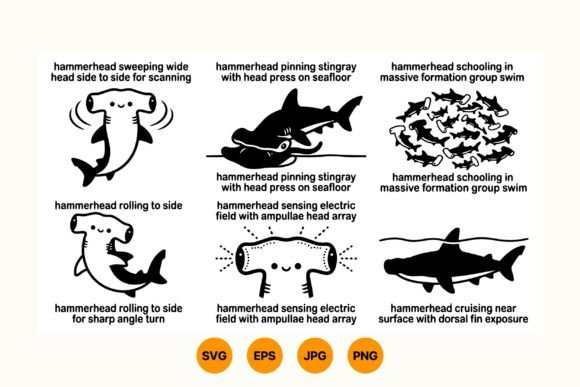
Thoughtful visual assets don’t just decorate—they clarify, connect, and reinforce. The Cute Hammerhead Shark Clipart is a precision-crafted design resource: a set of playful, flat-line, black-and-white illustrations capturing hammerhead sharks in diverse natural poses—swimming, turning, feeding, schooling, and resting—with clear behavioral labels. It’s not decorative filler. It’s functional infrastructure for educators building marine science units, designers crafting nature-themed branding, publishers developing children’s nonfiction, or curriculum developers assembling inclusive STEM worksheets.
Why This Clipart Fits Strategic Goals—Not Just Aesthetic Gaps
Most clipart fails at intentionality: it’s downloaded, dropped into a layout, and forgotten. The Cute Hammerhead Shark Clipart avoids that trap by being built for purpose—not just appearance. Its high-contrast monochrome palette ensures legibility across print, projection, and screen—even on low-resolution projectors in elementary classrooms or textured recycled paper used in eco-conscious educational kits. Its 100% vector foundation (SVG, EPS) means it scales from a 6mm icon on a flashcard to a 3m-wide mural in an aquarium lobby—without pixelation, distortion, or licensing friction. That technical reliability directly supports operational goals: reducing revision cycles, eliminating vendor dependencies, and accelerating time-to-print or time-to-publish.
More importantly, its behavioral specificity—each pose labeled with terms like “lateral scanning,” “tight-turn maneuvering,” or “benthic foraging”—turns passive imagery into active learning scaffolding. An educator doesn’t just show *a shark*; they anchor vocabulary, observation skills, and ecological reasoning in a single visual. A marine park communicator doesn’t just brand a newsletter—they reinforce accurate science while retaining warmth and accessibility. That alignment between form and function is where the Cute Hammerhead Shark Clipart delivers measurable strategic value.
When—and When Not—to Use It
Use this clipart when clarity, consistency, and scientific grounding matter more than stylistic novelty. It excels in contexts where audiences range widely in age or expertise: a kindergarten worksheet introducing animal adaptations, a middle-school infographic comparing shark sensory systems, or a community outreach poster explaining local marine conservation efforts. Its expressive yet uncluttered line work communicates quickly without oversimplifying biology—a rare balance.
Avoid deploying it as generic “ocean-themed” decoration. Slapping a hammerhead graphic onto a financial services brochure or a tech SaaS dashboard dilutes credibility and confuses messaging. Likewise, resist using it without context: an unlabeled shark image adds zero educational weight. The power lies in the pairing—label + pose + purpose. If your goal is emotional resonance alone, consider photography or custom illustration instead. The Cute Hammerhead Shark Clipart serves understanding—not just atmosphere.
Planning Your Integration—Three Practical Steps
- Map to Learning or Communication Outcomes First: Before opening the ZIP folder, define what your audience should know, do, or feel after engaging with your material. Is it recognizing how hammerheads use their cephalofoil to detect prey? Understanding why they school? Connecting anatomy to behavior? Let that outcome drive which poses and labels you select—not the other way around.
- Leverage Format Flexibility Intentionally: Need crisp icons for digital interactivity? Use SVG. Preparing offset-printed posters with tight color budgets? PNG or JPG at 300 DPI works reliably. Building editable marketing templates for a team? EPS files retain full vector editability in Adobe Illustrator. Don’t default to one format—match file type to workflow reality.
- Test Across Real Conditions: Print a sample on the exact paper stock you’ll use. Project it from the same laptop and projector your team uses in training. Load it into your LMS or CMS and check contrast on mobile devices. The black-and-white contrast holds up well—but only if deployed at appropriate stroke weights and sizing. A 4px line may vanish on small screens; scale accordingly.
Risks of Unintentional Use—and How to Mitigate Them
The biggest risk isn’t technical—it’s conceptual drift. Without clear goals, even high-quality assets become noise. You might unintentionally reinforce misconceptions: using a “leaping” pose (which hammerheads don’t do) without correction, or omitting key behaviors like electroreception scanning—leading learners to overlook how uniquely adapted these animals are. Worse, inconsistent labeling across materials—e.g., calling the same pose “hunting” in one poster and “exploring” in another—undermines trust in your content’s authority.
Mitigation starts with vetting. Review each labeled pose against peer-reviewed sources like NOAA Fisheries or the IUCN Shark Specialist Group. Cross-check terminology with grade-level science standards (NGSS, UK National Curriculum, or IB MYP). If adapting for younger audiences, simplify language—but never sacrifice accuracy. The Cute Hammerhead Shark Clipart includes scientifically grounded labels for exactly this reason: to support fidelity, not bypass it.
Long-Term Value Beyond the Download
This isn’t disposable content. Because it’s vector-based, resolution-agnostic, and license-clear (check included terms, but most commercial-use licenses apply), the Cute Hammerhead Shark Clipart compounds value over time. One educator can reuse it across five years of lesson updates. A marine nonprofit can adapt it for annual reports, social media campaigns, and volunteer training decks—maintaining visual continuity without redesign costs. A publisher can integrate it into multiple titles across age bands, adjusting labels and complexity while keeping core visuals consistent.
That longevity depends on disciplined curation. Store the original ZIP with version notes. Tag files by use case (“KS2_behavior_labels,” “aquarium_signage_300dpi”) rather than generic names. Document which poses align with which learning objectives—so future users (or your future self) can act decisively, not reactively. Treat the asset as part of your knowledge infrastructure—not just a download.
Strategic Observation: Simplicity Enables Precision
Flat-line art is often mistaken for “basic.” In practice, it’s highly disciplined. Removing color, texture, and shading forces focus onto shape, proportion, and gesture—the very elements that convey biological truth. A slight curve in the pectoral fin signals lift generation. The angle of the cephalofoil relative to the body indicates scanning orientation. These aren’t stylistic choices; they’re data points rendered visually. That’s why the Cute Hammerhead Shark Clipart supports deeper analysis than photorealistic alternatives: it strips away distraction to highlight function.
For creators balancing speed and substance, that discipline pays off. You spend less time editing shadows or matching palettes—and more time aligning visuals with pedagogy, messaging, or user experience goals. That shift—from production labor to strategic alignment—is where real efficiency gains emerge.
Final Decision-Making Guidance
Ask yourself: Does this asset help me communicate more accurately, teach more effectively, or operate more efficiently? If yes—and if you’ve matched its strengths to a concrete need—then the Cute Hammerhead Shark Clipart is likely a sound investment. If you’re choosing it because it’s “cute” or “on trend,” pause. Revisit your objective. Clarify your audience’s needs. Then decide—not based on aesthetics alone, but on whether this tool moves you measurably closer to your intended outcome.
Because the best creative decisions aren’t made at the download button. They’re made in advance—grounded in purpose, tested against reality, and aligned with long-term impact.