Customer Journey PowerPoint: Visualizing Experience, Strategy, and Growth in One Clean Template
In today’s fast-moving business environment, clarity isn’t a luxury—it’s a competitive necessity. Whether you're briefing a client, aligning internal teams, or presenting growth metrics to stakeholders, how you communicate customer experience directly shapes decisions. That’s where Customer Journey PowerPoint stands out: not as another generic slide deck, but as a purpose-built business infographic presentation template designed for precision, adaptability, and real-world use.
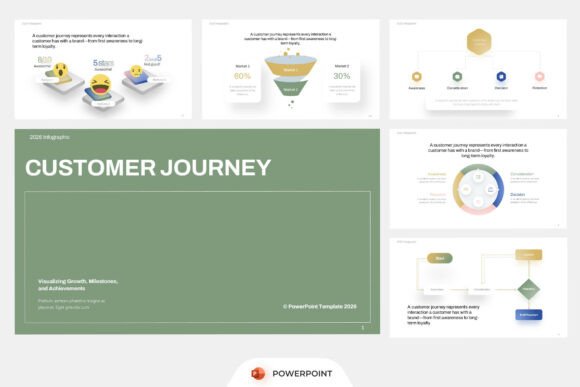
At its core, Customer Journey PowerPoint is a structured visual toolkit—built for mapping how customers interact with a brand across touchpoints, channels, and time. It goes beyond static charts: it includes ready-to-edit customer journey diagrams, flowcharts that trace decision paths, process timelines aligned with behavioral milestones, engagement stage breakdowns (awareness to advocacy), retention mapping frameworks, and data-driven infographic layouts—all optimized for storytelling with substance.
Why This Template Fits How Teams Actually Work Today
Modern marketing, sales, and product teams no longer operate in silos—and neither should their presentations. A growing number of professionals are shifting from linear reporting to collaborative, insight-led storytelling. Consider this: a startup founder pitching to investors needs to show not just revenue projections, but *how* users discover, try, trust, and return. A CRM manager preparing a quarterly review must translate raw behavioral data into intuitive visuals that spark discussion—not confusion. A branding agency building a campaign strategy can’t rely on abstract personas alone; they need to illustrate the emotional and practical shifts that happen between first click and final purchase.
Customer Journey PowerPoint responds directly to that shift. Its 16:9 widescreen ratio matches modern display standards—from conference room screens to remote meeting thumbnails. The editable slides allow quick adaptation without design overhead. And because every element is fully customizable—including colors, icons, labels, and layout structure—it supports iterative work: revise a funnel stage after new survey data arrives, adjust a retention timeline post-launch, or swap out engagement metrics for a different audience segment—all within minutes.
From Theory to Tactical: What Makes It Practical, Not Just Pretty
Many templates promise flexibility but deliver friction. Customer Journey PowerPoint avoids that trap by prioritizing usability without sacrificing depth. The included help guide isn’t an afterthought—it walks users through layer logic, icon conventions, and common customization patterns. Free fonts ensure consistent rendering across devices and platforms. And because all image stock is intentionally excluded, users retain full control over brand-aligned visuals—no licensing surprises, no placeholder distractions.
This matters in practice. For example, a small marketing agency might use the engagement stages layout to compare two audience segments side-by-side: one responding strongly to email nurturing, another driven almost entirely by social proof and peer reviews. With editable text boxes and modular diagram sections, they can update both versions in the same file—then export clean PDFs for client handoffs or embed live slides into a Notion dashboard for ongoing team reference.
Similarly, educators teaching digital marketing can assign students to map a real local business’s journey using the template’s retention mapping framework—focusing on observable behaviors (repeat visits, referral rates, support ticket trends) rather than assumptions. The structure guides analysis while leaving room for interpretation and evidence-based reasoning.
How Customer Experience Mapping Is Evolving—and Why Clarity Matters More Than Ever
Customer journey mapping has moved far beyond early-stage UX exercises. It’s now embedded in strategic planning, compliance reporting, product roadmaps, and even investor due diligence. What’s changed isn’t the concept—but the expectations around it. Stakeholders no longer want “a journey map.” They want *the right journey map*: contextualized, measurable, tied to business outcomes, and updated regularly.
That evolution reflects broader shifts: rising customer expectations for personalization, tighter budgets demanding clearer ROI attribution, and increased scrutiny on data ethics and transparency. A static, one-off diagram no longer meets those needs. Instead, teams need living assets—templates that support versioning, annotation, integration with analytics tools (via exported data labels or manual sync), and cross-functional review.
Customer Journey PowerPoint supports that evolution by offering structure *without* rigidity. Its flowcharts aren’t locked into rigid funnels—they’re built to reflect non-linear paths (like research → trial → pause → re-engagement). Its timeline layouts accommodate variable durations between stages, acknowledging that B2B purchases may span months while app onboarding happens in minutes. That realism makes the template useful—not just illustrative.
Who Benefits—and How They Use It Differently
The versatility of Customer Journey PowerPoint lies in how differently professionals apply it—based on role, scale, and goal:
- Startups use the sales funnel slides to pressure-test assumptions before building tech infrastructure—mapping hypothetical drop-offs to identify where messaging, pricing, or UX might need refinement.
- CRM analysts layer behavioral data onto the retention mapping layouts, color-coding segments by lifetime value or churn risk to surface patterns that spreadsheets alone don’t reveal.
- Business consultants combine the audience analysis framework with qualitative interview quotes, placing verbatim insights directly alongside journey stages to ground strategy in human context.
- Educators and trainers repurpose the process timelines as interactive classroom tools—hiding or revealing stages to prompt group discussion about cause-and-effect relationships in customer behavior.
- Freelancers and solopreneurs leverage the clean, branded-ready design to build custom proposals—embedding journey visuals that show clients exactly how their investment translates into improved touchpoint experiences.
Realistic Expectations: What It Does Well—and Where Human Judgment Still Leads
It’s important to be clear: Customer Journey PowerPoint doesn’t replace research, data analysis, or strategic thinking. It doesn’t auto-generate insights from your CRM or predict future behavior. What it does exceptionally well is provide a shared language—a visual scaffold that makes complex interactions understandable, debatable, and actionable.
For instance, a retail brand noticing declining post-purchase satisfaction might use the engagement stages layout to isolate where friction occurs—not just “after checkout,” but specifically during returns initiation or loyalty program enrollment. That specificity changes the conversation from vague improvement goals to targeted experiments: simplifying return instructions, adding progress indicators, or embedding loyalty prompts at the optimal moment.
The template also helps avoid common pitfalls—like conflating marketing channels with actual user behavior, or assuming uniformity across segments. Its modular design encourages labeling assumptions (“Based on Q3 survey data”), citing sources, and flagging gaps (“Needs voice-of-customer validation”). That transparency builds credibility and invites better questions—not just agreement.
Moving Forward—Without Overcomplicating
As workflows grow more distributed and attention spans tighten, the value of well-structured, instantly adaptable presentation assets continues to rise. Customer Journey PowerPoint meets that need without over-engineering. It doesn’t chase every trend—no AI integrations, no animated transitions, no forced gamification. Instead, it focuses on what hasn’t changed: the need for accurate, empathetic, and actionable representations of how people experience brands.
Whether you’re refining a go-to-market plan, preparing a board update, teaching foundational concepts, or simply trying to align your team around a shared understanding of your customers—you’re not just selecting a template. You’re choosing a tool that supports clarity over clutter, insight over ornamentation, and collaboration over static delivery. And in a world where miscommunication carries real costs, that’s not just convenient. It’s essential.