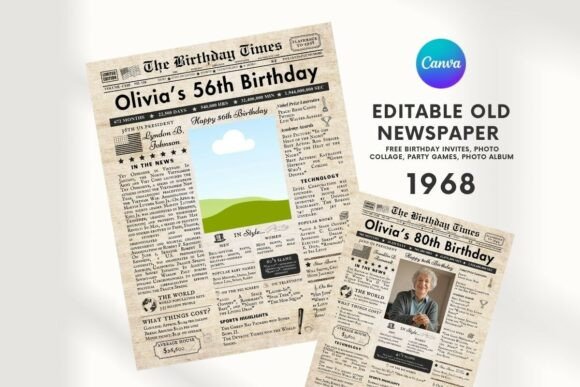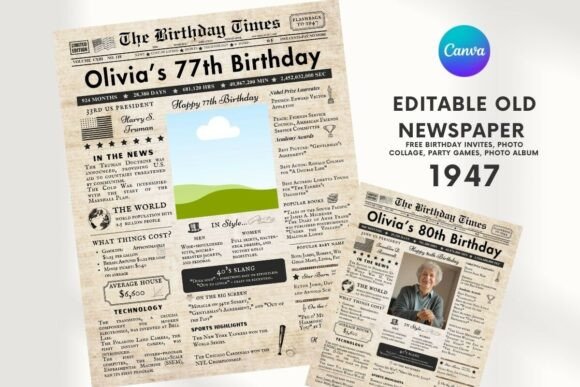
EDITABLE 77 Birthday Newspaper
There’s something quietly powerful about holding a birthday newspaper in your hands—crisp paper, thoughtful typography, headlines that tell a life story instead of just announcing a party. The EDITABLE 77 Birthday Newspaper isn’t just another Canva template. It’s a tactile, nostalgic storytelling tool designed for people who believe celebrations deserve depth, not just decoration.
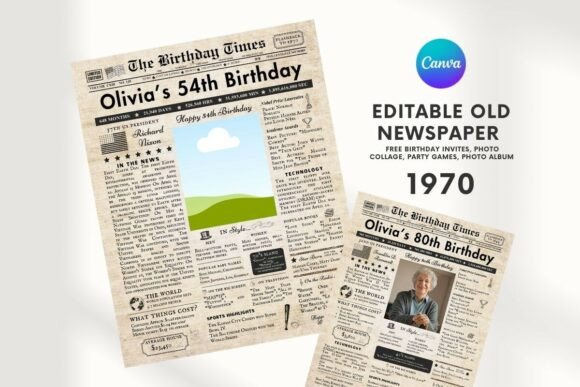
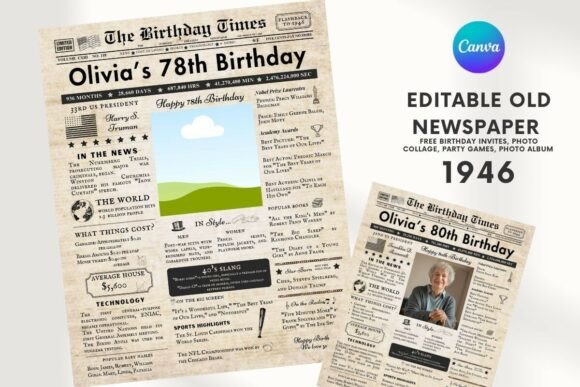
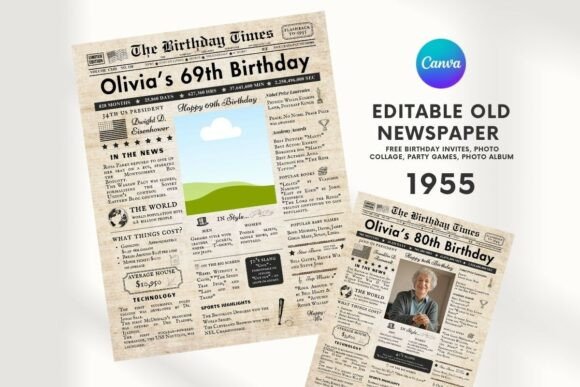
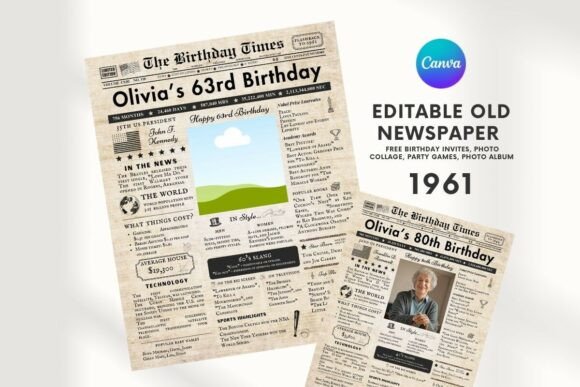
Visually, it leans into mid-century editorial charm: clean serif headlines, generous white space, subtle grid structure, and a layout that feels both authoritative and warm. Think vintage broadsheet meets modern design sensibility—no forced whimsy, no cluttered graphics. The type hierarchy is intentional: bold section headers anchor each story, body text remains highly legible at print sizes, and pull quotes or fun facts sit comfortably alongside photos or illustrations. It doesn’t shout. It invites attention—and holds it.
More Than a Template—A Narrative Framework
This isn’t a fill-in-the-blank invitation. It’s a framework for curation. You decide what makes the celebrant’s 77th year meaningful: a timeline of career milestones, handwritten notes from family members, a “Top 10 Life Moments” list, or even a playful “Weather Report” from their birth year. Because it’s fully editable in Canva, you control tone, pacing, and emphasis—whether you’re designing for a quiet family brunch or a lively community gathering.
The template includes clearly labeled layers: masthead, byline, lead article, sidebars, photo captions, and even a weather/forecast box (yes, it’s charmingly literal). Nothing is locked or flattened. You can swap fonts within Canva’s editor, adjust spacing to suit your content density, and reposition elements without breaking alignment. That flexibility matters—especially when you’re balancing sentiment with structure.
Where This Design Shines—Beyond the Birthday Table
While built for milestone birthdays, the EDITABLE 77 Birthday Newspaper works surprisingly well across other contexts where authenticity and narrative weight matter:
- Editorial design: As a mini-zine for retirement tributes, alumni spotlights, or donor appreciation in nonprofit communications.
- Brand storytelling: Small businesses use it to launch founder anniversaries, product milestones, or team retrospectives—giving corporate moments human texture.
- Social media assets: Export individual sections as high-res social cards—headline + quote + photo—creating cohesive, scroll-stopping posts.
- Printed keepsakes: When printed on matte or recycled stock, it becomes a physical artifact—not disposable decor, but something folded into a memory box or framed beside graduation photos.
Its strength lies in how it bridges digital convenience and analog resonance. You build it online, but its impact lands offline—in hands, on coffee tables, tucked into gift bags.
Typography That Supports, Not Distracts
The default font pairing uses a sturdy, slightly condensed serif for headlines (think timeless newspaper authority) and a warm, open sans serif for body copy—designed for readability at 10–12 pt in print. Neither font is flashy, and that’s the point. Legibility trumps novelty here. You want guests to absorb stories, not decode letterforms.
If you choose to customize fonts in Canva, keep contrast in mind: pair a strong display serif with a neutral sans, or soften the tone with a gentle humanist sans—but avoid script or decorative fonts for body text. At 77 years old, clarity isn’t optional. It’s respectful.
Also consider scale. On-screen previews often overstate legibility. Always export a test PDF and zoom to 100%—or better yet, print one page at actual size. Does the subhead still read cleanly? Do photo captions hold up next to images? These aren’t nitpicks—they’re part of honoring the person whose story you’re telling.
Real-World Usage Tips From Design Practice
We’ve seen this template used most effectively when creators follow three simple habits:
- Start with content, not color. Draft your headlines, quotes, and captions first—even as plain text. Layout follows meaning, not the other way around.
- Repurpose, don’t reinvent. Pull existing photos, scanned letters, or voice memo transcripts. One handwritten note scanned and dropped into a sidebar adds more warmth than five stock illustrations.
- Leave room for silence. Don’t feel compelled to fill every column. A well-placed blank space—like a pause in speech—lets readers breathe and reflect.
And if you’re using this commercially—say, as a service offering for clients—check Canva’s licensing terms. While the template itself is free to edit and download, commercial redistribution (e.g., selling the unaltered file) isn’t permitted. But turning it into a custom-designed deliverable for a client? Absolutely fair game—and a smart differentiator in crowded creative markets.
A Thoughtful Alternative to Standard Party Gear
In an era of digital invites and fleeting social posts, the EDITABLE 77 Birthday Newspaper offers something increasingly rare: intentionality. It asks you to slow down, to select, to reflect—not just decorate. That effort shows. Guests notice. The celebrant feels seen—not just celebrated.
It also sidesteps visual fatigue. No glitter overlays, no animated GIFs competing for attention. Just clean lines, considered spacing, and space for real words. That restraint is what makes it feel premium—not because it costs more, but because it demands more thoughtfulness from the creator.
Whether you're a marketer building emotional connection through storytelling, a designer crafting a personal gift with professional polish, or a family member wanting to honor decades of presence—it works because it serves the story first, and the occasion second.
So before you reach for the next generic party pack, ask: What would make this birthday feel like a chapter worth revisiting? With the EDITABLE 77 Birthday Newspaper, the answer isn’t just in the design—it’s in what you choose to say, and how thoughtfully you say it.