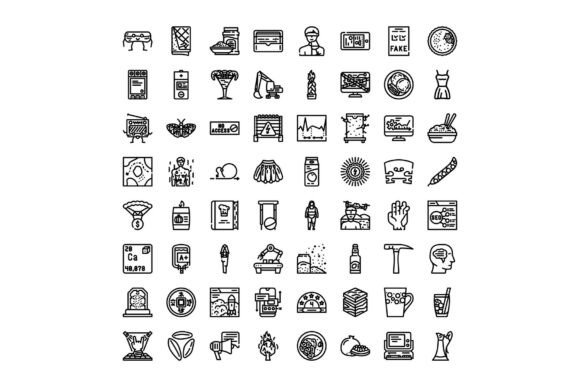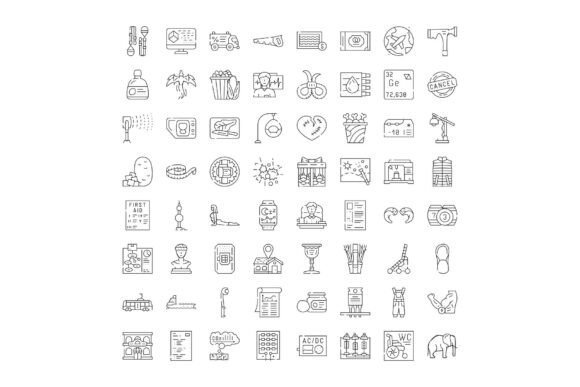
Collection of Thin Line Universal Vector
The Collection of Thin Line Universal Vector refers to a curated set of scalable, minimalist vector graphics rendered in consistent thin-line strokes. These symbols span everyday objects (e.g., coffee cup, calendar, envelope), abstract concepts (e.g., growth, connection, security), tools (e.g., wrench, code bracket, palette), and activities (e.g., meeting, travel, learning). Designed for clarity and adaptability, each glyph follows a unified visual language—uniform stroke weight, open negative space, and neutral geometry—making them suitable for digital interfaces, data visualization, and instructional materials.
Why Designers and Developers Consider This Collection
Professionals evaluating icon resources often prioritize consistency, scalability, and integration efficiency. The Collection of Thin Line Universal Vector appeals primarily because it addresses recurring practical constraints: the need for lightweight assets that scale cleanly across devices, maintain legibility at small sizes, and harmonize with modern UI frameworks. Its emphasis on universality means symbols avoid culturally specific or overly stylized interpretations—supporting internationalization and accessibility goals without requiring custom adaptation.
Users commonly explore this collection when building dashboards, mobile applications, documentation sites, or educational infographics. Its thin-line aesthetic aligns well with current design trends favoring restraint and spatial clarity, especially where content density must remain high without visual clutter.
Key Benefits for Practical Implementation
Several functional advantages support its adoption:
- Technical efficiency: SVG-based vectors load quickly, require no raster fallbacks, and integrate natively into CSS and React/Vue components via inline SVG or icon fonts.
- Visual coherence: Uniform stroke width and proportional spacing reduce cognitive load—users recognize patterns faster across menus, tooltips, or status indicators.
- Customization flexibility: Stroke color, thickness (within limits), and fill state (outline-only or semi-filled) can be adjusted programmatically, enabling theme switching and responsive contrast adjustments.
- Licensing clarity: Most licensed versions permit commercial use, redistribution in compiled products, and modification—critical for SaaS platforms and white-labeled tools.
Tradeoffs and Realistic Expectations
No icon system is universally optimal. The Collection of Thin Line Universal Vector trades expressive detail for structural simplicity. Symbols optimized for minimalism may lack immediate recognizability for niche or ambiguous concepts—such as “blockchain,” “neural network,” or “consent.” In those cases, users may need supplemental text labels or contextual cues to ensure comprehension.
Additionally, thin-line icons perform less effectively at very small sizes (below 16px) or on low-resolution displays, where stroke definition blurs. Testing across target device densities remains essential. The collection also assumes a baseline familiarity with symbolic conventions—for example, using a gear for “settings” or a bell for “notifications.” Teams supporting audiences with limited digital literacy may need to validate symbol associations through usability testing.
Finally, while the set covers broad categories, it does not include every possible variation. Users needing highly specialized icons—like medical equipment, industrial machinery, or domain-specific notation—will likely supplement with custom assets or complementary libraries.
When This Collection Is a Strong Fit
The Collection of Thin Line Universal Vector works best in scenarios where:
- A product’s design system already favors light, airy interfaces with generous whitespace and restrained color palettes;
- Development teams prefer predictable, maintainable icon implementation—avoiding inconsistent third-party imports or bespoke SVG management;
- Content spans multiple languages or regions, and visual neutrality supports broader interpretability;
- Infographics emphasize comparative relationships (e.g., flowcharts, process maps, capability matrices) rather than narrative storytelling;
- Performance budgets are tight, and reducing HTTP requests or bundle size is a priority.
In these contexts, the collection reduces decision fatigue during asset selection and accelerates prototyping—especially when paired with automated icon component libraries or Figma plugins that support batch import and style mapping.
When Alternatives May Be More Appropriate
Consider other solutions if your project requires:
- Highly differentiated visual hierarchy: Thick-line or filled icons often stand out more strongly in dense toolbars or on dark backgrounds. A mixed-weight system may better serve complex enterprise applications.
- Dynamic or animated states: While static thin-line vectors are stable and performant, they offer limited built-in support for micro-interactions (e.g., pulsing alerts, loading rotations). Custom animation may be needed.
- Strict WCAG contrast compliance at small sizes: Some thin-line glyphs fall below recommended luminance contrast ratios when rendered in light gray on white. Adjusting stroke weight or adding subtle fills may be necessary—and could compromise the original aesthetic intent.
- Industry-specific regulatory alignment: Healthcare, aviation, or safety-critical domains often mandate ISO-standardized symbols. Generic universal vectors rarely meet those exact specifications without verification and potential redesign.
Making an Informed Decision
Evaluating the Collection of Thin Line Universal Vector should begin with concrete use cases—not abstract preferences. Start by auditing your current or planned interface elements: list every icon currently used or anticipated, then map each to the collection’s available symbols. Note gaps, ambiguities, or mismatches in meaning or tone.
Next, assess technical constraints. Does your stack support SVG spriting or dynamic color injection? Are your designers comfortable adjusting stroke properties without breaking alignment? Can your team test legibility across real user devices—not just high-end monitors?
Also consider long-term maintenance. A tightly scoped collection simplifies updates but may require external sourcing for future needs. Evaluate whether the vendor provides versioned releases, changelogs, and backward compatibility guarantees—especially if integrating into a design system used across multiple products.
Finally, compare licensing terms against deployment scope. Some versions restrict usage to single projects or prohibit embedding in downloadable desktop apps. Confirm permissions match your distribution model before committing to integration effort.
Conclusion
The Collection of Thin Line Universal Vector is a purpose-built resource—not a one-size-fits-all solution. Its value emerges most clearly in environments prioritizing consistency, scalability, and cross-platform fidelity over stylistic flourish or maximalist expression. For teams balancing speed, clarity, and maintainability in UI and infographic work, it offers a rational, testable foundation. However, its suitability depends entirely on alignment with specific functional requirements, audience needs, and technical realities—not on trend alignment alone. Careful scoping, targeted validation, and realistic expectations ensure it serves as a tool—not a constraint.